The Last Nobel That Surprised Everyone
The 2024 Nobel Prize in Chemistry announced a seismic shift in how we do science. For the first time in its 123-year history, the prize was awarded explicitly for AI-driven discovery. Half the prize went to Demis Hassabis and John Jumper at Google DeepMind for AlphaFold2. The other half went to David Baker at the University of Washington for de novo protein design — the ability to design proteins from scratch that have never existed in nature.
What made this surprising wasn't the recognition. It was the frankness of it. For decades, scientists had used computational tools as servants — helpful accessories to a fundamentally human process. The 2024 prize said something different: the machines have become protagonists. They haven't replaced scientists. They've become the architects. We're the apprentices now.
And the apprentices are learning fast. Somewhere in a lab, an AI-designed drug is working. Not in theory. Not in simulation. In a human body. The first AI-designed drug molecule to enter Phase II clinical trials — Insilico Medicine's INS018_055 for idiopathic pulmonary fibrosis — got there in 30 months. The old path took 5 to 7 years. We just compressed a decade into two and a half years.
Reading the Code Evolution Wrote
Before you can write proteins, you have to understand what they are. A protein is a string of amino acids — 20 different types, arranged in a sequence like letters in a language. Insulin. Hemoglobin. The antibodies in your immune system. The enzymes that digest your food. Everything your body does, proteins do it.
But a protein's sequence — its primary structure — is only half the story. What matters is its shape. The same sequence can fold into wildly different 3D architectures. And the shape is everything. Shape determines function. A protein that folds wrong doesn't work. It might even poison you. Structure is destiny in biochemistry.
Evolution spent four billion years writing millions of different proteins, each one an intricate puzzle of how to fold amino acids into a working machine. For most of human history, we could only read what evolution had already written. We looked at proteins from living things — studied them in the lab, mapped their structures painstakingly, one by one. Each structure took years.
AlphaFold: The Problem That Took 50 Years
The protein folding problem is simple to state: given a sequence of amino acids, predict its 3D structure. Solving it was hard enough that it became the Mount Everest of computational biology. For 50 years, the best methods were still crude. They could make educated guesses, but they made mistakes constantly.
Then, in December 2020, DeepMind released AlphaFold2. It didn't just solve the problem better. It abolished the problem. In a single leap, it predicted the 3D structure of virtually every known protein — about 200 million structures — in 18 months. Before AlphaFold2, solving a single protein structure took years in a lab. Some proteins had been studied for decades without yielding their secrets.
John Jumper and the AlphaFold team used a deep learning technique called an attention mechanism — the same mathematical trick that powers modern language models. They trained it on known protein structures. The network learned to recognize patterns in how sequences fold. It learned the physics of it, implicitly. When it finished, it could predict novel structures with stunning accuracy. The entire structural universe of life, mapped in 18 months.
From Reading to Writing: De Novo Design
Reading is powerful. Writing is revolutionary. David Baker's lab at the University of Washington had already been pushing into de novo protein design — designing proteins that don't exist in nature, optimized for functions that evolution never needed. They'd designed proteins that neutralize viruses, proteins that deliver drugs to tumor cells, proteins that catalyze chemical reactions no natural enzyme has ever performed.
But designing proteins was slow. It required expert intuition, vast computational power, and patience measured in months. Then, in 2023, the Baker Lab released RFdiffusion — a new tool that uses diffusion models, the same mathematical framework that powers image generators like Stable Diffusion. Instead of generating pictures of dragons and cities, RFdiffusion generates novel protein sequences. Functional proteins. In seconds.
RFdiffusion learns the underlying rules of protein design — what makes a fold stable, what makes a binding pocket work — and then uses those rules to generate entirely new sequences that obey the same laws but have never existed. It's like learning the grammar of a language and then composing poems in it that no poet ever wrote.
The First Drugs Born from Nothing
These aren't hypothetical achievements anymore. In 2023, Insilico Medicine began Phase II trials for INS018_055, a drug molecule designed entirely by AI to treat idiopathic pulmonary fibrosis — a disease with no cure, in which lung tissue scars and hardens until the patient can't breathe. The molecule was designed to target a specific protein implicated in the disease. From target identification to clinical trial entry: 30 months. The traditional path takes 5 to 7 years.
In parallel, Generate Biomedicines designed GB-0669, an antibody that targets a region of SARS-CoV-2 previously thought to be "undruggable" — too flexible, too exposed to immune attack, too hard to hit. Their AI found a way to hit it anyway. In Phase I trials now. Design to clinic: 17 months.
These timelines are what startups dream about. These are the numbers that change the game. If AI can reliably cut drug development time in half, and if it can tackle targets that traditional methods couldn't touch, then the disease space that's "druggable" just exploded. Conditions we wrote off as incurable suddenly have a path forward.
The Protein Universe: A Space Larger Than Imagination
The scale of what's possible is hard to grasp. The number of possible protein sequences — combinations of the 20 amino acids in different lengths — is estimated at 101300. That's a number with 1,300 zeros. To put it in perspective, there are only about 1080 atoms in the observable universe.
Evolution has explored a negligible fraction of this space. It had four billion years and produced millions of proteins. Evolution stumbled around in a vast library and checked out a handful of books. AI can now navigate this space systematically. It can ask: what proteins have never been written, but could work? And it can generate candidates in seconds.
This is what makes de novo design so powerful. You're not constrained by evolution's accidents, its evolutionary path dependencies, its random compromises. You can design for the function you want. Need a protein that breaks down plastic? RFdiffusion can search that corner of the protein universe. Need an antibody against a moving target? Design it. The universe of possible proteins is so vast that almost anything you want probably exists in it somewhere — evolution just never had the time to find it.
"We are no longer just reading the proteins evolution wrote. We are writing new ones. For purposes evolution never imagined."
— Baker Lab, University of Washington
"AlphaFold has solved a fifty-year-old problem. What follows is not just a scientific achievement — it is a new capability of our species."
— Dame Janet Thornton, EMBL-EBI
"The same mathematical framework that generates images of dragons and cities is now generating proteins that could cure diseases no drug has ever touched."
— Nature Reviews Bioengineering, 2025
The Dual-Use Shadow
Every powerful technology casts a shadow. The same capability that lets us design proteins to heal could design proteins to harm. De novo protein design could, in principle, design novel pathogens or toxins with no known natural countermeasures. The weaponization risk is real. The National Academies of Sciences has flagged this as one of the most acute emerging biosecurity risks.
The field knows this. It's actively debating governance. Some proposals include mandatory screening of AI-designed sequences before synthesis — a kind of biosecurity checkpoint. Others discuss international oversight. The stakes are high enough that the scientific community is trying to get ahead of the problem, instead of reacting after it's too late.
The Pen That Writes Life
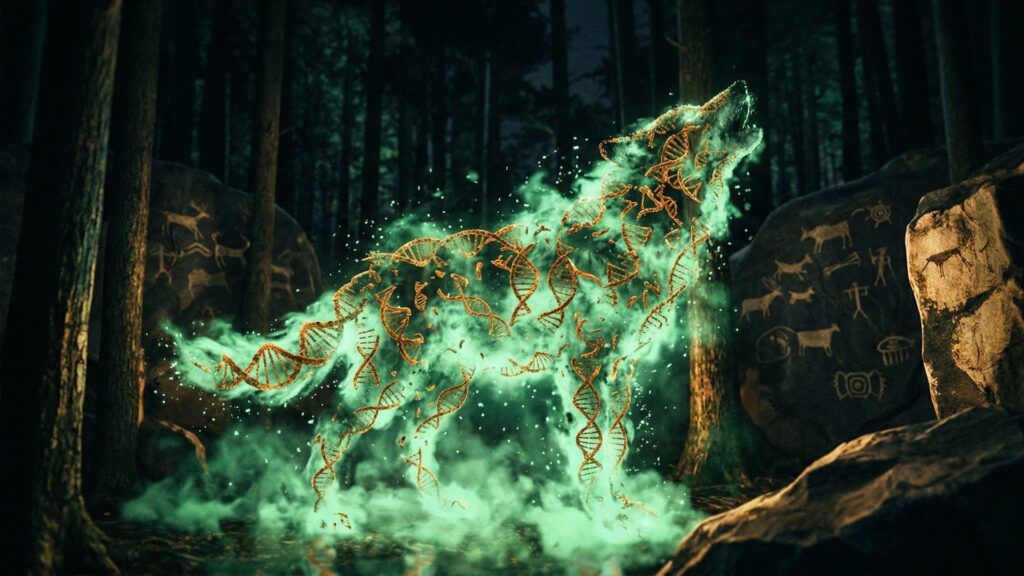
We have given ourselves a pen that writes life. Not metaphorically. Literally. We can now write sequences of amino acids and produce functional proteins that have never existed. We can heal diseases. We can create enzymes that break down pollutants. We can design antibodies against targets we couldn't touch before.
The question is not whether we can do this. We can. The question is: who decides how we use it? How do we ensure that this power remains in service to health, not bioweapons? How do we make sure the benefits reach people who need them, not just the wealthy? How do we navigate the transition from a world where biology was a read-only archive of what evolution created to a world where we're writers?
The 2024 Nobel Prize wasn't just recognizing achievement. It was marking a threshold. We crossed it. Now comes the harder part: deciding what to do on the other side.
 Buy me a coffee