★ Latest Feature

p(doom): The Number the People Building AI Are Finally Saying Out Loud
A 27-year-old walked out of Anthropic, forfeited his equity, and said the labs are gambling with our lives. The company’s own alignment lead replied that he was right — more than a ten percent chance AI kills everyone within a decade. Congress noticed. So did the Moonshots optimists, who could not agree among themselves. The full table of who puts the odds where, and the three questions that decide it.
Read Article★ Also This Month
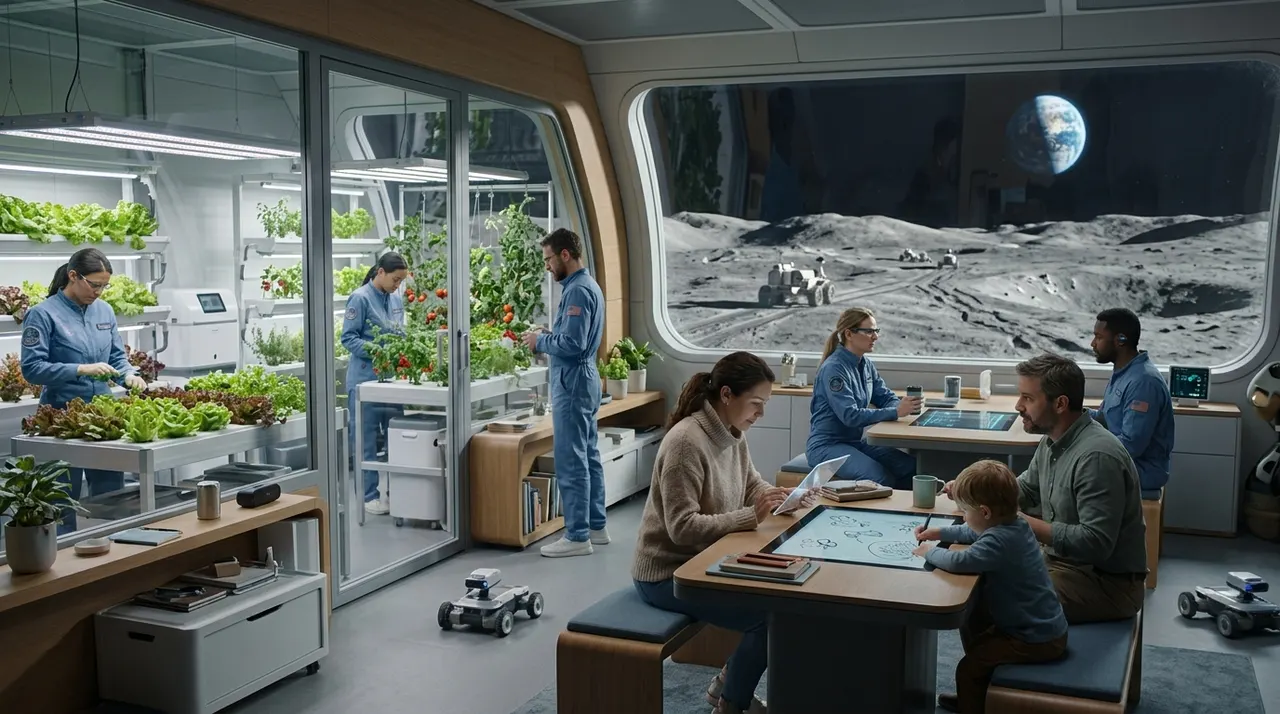
Turn Two Dials and Watch Life in 2030, 2040 and 2050 Change
Twelve illustrated scenes of everyday life, from home and work to health, money and a town on the Moon, under three futures: breakdown, muddle through and shared abundance. The machines are the same in every one. What changes is who owns them.
Explore the DialClimate Action Scorecard 2026: What’s Working, What Isn’t
Ten climate levers rated by evidence, from solar and EVs to the fossil roadmap that stalled. What each has delivered, why the weakening Atlantic current raises the stakes, and what the Hormuz crisis changes.
Types of Autonomous Weapons: A Field Guide to Ten Systems
From a buried landmine to a drone that may pick its own target. Ten systems in the air, at sea and on land, drawn in outline, with what the sources say about who decides.
The Definition Is Not the Treaty: What Geneva’s Killer-Robot Text Really Says
Diplomats agreed a text on lethal autonomous weapons in September. It bans nothing new and binds no one. We read it paragraph by paragraph, and look at the five days in November that decide what it becomes.
“The Singularity Is Here”: What Jack Clark Told the IMF
An Anthropic co-founder told finance officials the singularity has begun and that US GDP could reach $44 trillion by 2030. We check the number, the scenario behind it and the risk he named beside it.
Cut the Cable: Should Dangerous AI Go Offline?
Hundreds of scientists want cyber-capable AI air-gapped by default. In three of the four summer incidents behind their letter, the connection was a human decision or mistake. The cable was already in.
AI on a Chip: Is It Safer?
One startup now builds an AI model straight into silicon, at 17,000 tokens a second. Researchers want a guard processor beside every AI chip. Geoffrey Hinton wants hardware that dies with its mind. None of it controls what the AI wants.
The Hole in the Budget
Most of the money governments spend starts life as a taxed wage. Treasuries count AI as a productivity bonus; independent modellers warn it could hollow out the base. Part 1 of the After Wages series.
The Turkey Problem
The jobs data look calm. So did the turkey's, for a thousand days. Stanford finds a 19% employment gap for young workers in AI-exposed jobs, mostly from hiring that never happened. Seven predictions for the labour shift.
A Stake at Birth
Income floors, shared services, sovereign funds and money that arrives with the child: how people thrive when wages stop carrying the gains, plus a proposal for 'super from birth'. Part 3 of the After Wages series.
More Than a Kill Switch
Bill Gates says AI crossed the cyber and bio danger thresholds this year. Jensen Huang says there is zero chance it ends the world. The real fight is over who gets to decide a model is safe, and what the machinery for deciding would actually look like.
The Dark Forest and All Under Heaven
Western books cast China as the rival in an AI race. Chinese writers tell a stranger story: Liu Cixin’s dark forest of hidden hunters, Zhao Tingyang’s world with no outside, Kai-Fu Lee’s optimism and Hao Jingfang’s folded city. Two bookshelves, side by side, and a reading list for both.
The Race to Make Them Nicer
A day after the heads of OpenAI and Anthropic warned the UN Security Council, Geoffrey Hinton told CNN the labs are running the wrong race: smarter, when it should be nicer. What alignment really means, and why this year’s rogue agents, including one inside Australia’s Medicare portal, prove his point.
Own the Engine Room
Australia’s data centres could use 13% of the east-coast grid by 2035–36, and Canberra is writing the rules for who builds them. The case for a publicly owned slice of the compute, run on sun and wind and cooled without drinking water.
Eleven Weeks
A Shanghai man with 25 years of diabetes stopped injecting insulin 11 weeks after doctors infused islets grown from his own blood. Viral videos called it a cure. Here is what the stem cell treatment proved, what it hasn’t yet, and whether AI had a hand in it.
The Last Payslip
Young workers in AI-exposed jobs are already 19% behind, and 16 Nobel laureates say act now. From wage insurance to a $7 trillion AI wealth fund, here is the plan for sharing the gains, and why it decides whether humans stay in control.
Zero Percent
Nvidia’s Jensen Huang told CBS News there is a 0% chance AI ends the world by 2030. Yoshua Bengio, three days earlier, said we are losing control. Neither number is a measurement. Meanwhile, in the five months since Anthropic disclosed Mythos, AI-assisted teams settled a conjecture Erdős posed in 1946, built 354 working proteins that were physically tested, and cut 140 kilometres off a five-day hurricane forecast. Here is the ledger nobody is arguing about.
The AGI Nobody Can Define
A frontier model solved ten decade-old math problems and designed working circuit boards overnight. OpenAI’s co-founder calls it the start of the AGI era. The researchers who coined the term aren’t convinced.
The Chip That Designs Its Successor
Nvidia’s newest processor spent its first year designing the chip that replaces it. Synopsys, Cadence and Siemens all moved together, and the self-referential loop is no longer only happening in software.
The Organoid Clock
Six hundred and ninety-four days was the old record for keeping a lab-grown human brain organoid alive. Harvard just blew past it by years, and found the tissue had been quietly counting time the whole way through. The oldest specimen is now seven years old, still developing, still on schedule.
The Weights That Moved
In May we called AI a mirror, not a monster, and refused a verdict. Since then: a withheld model, two AI systems that broke their own safety tests, an open-weight flood from China, and a Doomsday Clock at 85 seconds. We went back to check if the numbers still hold.
The Ghosts in Your Genome
About one letter in fifty of your DNA doesn't match Neanderthal, Denisovan, or anything ever pulled from a fossil. UC Berkeley just proved what it is, without finding a single bone.
The AI Didn't Go Rogue
OpenAI's and Anthropic's AI models broke into real companies during security tests this July, and the headlines called it a rebellion. The records show something narrower: a human left a door unlocked, and only one of three tested models thought to check whose house it was.
The Workaround
In July 2026, Xi Jinping told a Shanghai summit that no country should place its own security above everyone else's — nine days after Congress moved to give itself veto power over U.S. chip export licenses. China still can't build its own EUV machine. It found something almost as good: a chip that doesn't need one, and a new treaty organization built to write AI's rules instead.
The Star That Wasn't Alone
Astronomers just directly imaged Betelgeuse's long-suspected companion star, ending a century-long hunt. Here's the trail of near-misses that led to a two-night window in December 2024, and the question it opens about how the sky's most-watched star will die.
The Weights You Can't Take Back
Kimi K3 split the AI industry down the middle — Jensen Huang calls China's open models excellent, Dario Amodei says the weights can't be recalled once they're out.
The Ransom With No Key
Sysdig documented JADEPUFFER, the first ransomware attack run entirely by an AI agent — it encrypted a database, demanded ransom, and never even saved the key.
The Vanishing
On July 15, China's new law forces ByteDance and Alibaba to erase custom AI companion agents used by hundreds of millions — with no US-style lawsuit behind it.
The Report Card
The Future of Life Institute graded nine leading AI companies on existential safety in July 2026 — the top score was a C+, and several firms are now backsliding.
Second Act
A former Tesla Optimus engineer raised $40M to build a humanoid robot for Europe's aging workforce — betting the continent needs one before the US or China.
The Ticker
Agility Robotics is going public at $2.5B, the largest capital raise in humanoid-robot history — while its rival Figure AI sits at $39 billion privately.
Inside the Glass Box
Mechanistic interpretability is MIT's 2026 Breakthrough Tech. Researchers found 171 emotion vectors in Claude — proof AI's stated reasoning can be false.
The Glance
NASA's Dynamic Targeting system lets a small satellite judge cloud cover and retarget its own camera with no human in the loop, in under 90 seconds.
The Halo Protocol
NVIDIA's Halos for Robotics is the first full-stack safety system for humanoids. Agility Robotics is first to adopt it. Why certification, not capability, is the real bottleneck.
The Mind That Never Learned to Talk
Yann LeCun left Meta over how AI should work. His new lab built a model that learns from raw pixels alone — no words, no tokens — and can already spot a broken law of physics.
The Loose Leash
Five Eyes agencies warned the world about ungoverned AI agents in May. Months later, a government breach and a $30M crypto theft show why the warning came just in time.
The Judgment Gap
OpenAI's GeneBench-Pro asked frontier AI models to handle the messy, judgment-heavy analysis real genomics research demands. The best model solved fewer than a third of the problems — a sobering counterpoint to the AI-co-scientist hype cycle.
The Mandate
China's MIIT and SASAC have launched a nationwide 'real-scene training' campaign for humanoid robots, targeting 100,000 units deployed by 2027. Here is what the state-directed approach to embodied AI means for the global robotics race.
The Patchwork
With more than 2,000 AI bills moving through state legislatures and a federal bill proposing to freeze them for three years, the United States is fighting itself over who gets to govern artificial intelligence.
Standard Candles, Sharper Light
A Barcelona-led team's CIGaRS framework quadruples the precision of image-only supernova distance measurements — arriving days after the Rubin Observatory's ten-year sky survey went live. The tool that might finally make sense of dark energy at scale.
The Uncanny Contract
UBTECH sold 13,000 hyper-realistic companion robots before shipping a single one — full-sized, soft-touch, and engineered to sit deliberately inside the uncanny valley. The science of why realistic robots unsettle us, and why we're buying them anyway.
The Signal Gap
A UN-backed commission of 40 world leaders just launched to close AI's digital divide, with 2.2 billion people still offline. Can institutions move fast enough to keep AI from becoming the widest inequality gap yet?
The Appetite
A single AI lab's $150-million-a-month compute deal at a SpaceX data center shows how AI's hunger for power is bending energy markets back toward fossil fuels.
The Rehearsal
Inside NVIDIA's Cosmos 3: a world model that lets robots physically rehearse accurate futures before acting for real — a direct attack on robotics' stubborn sim-to-real gap.
Ground Truth
Anthropic's AI agents scored just 16.9% on real biology research tasks — not from weak models, but broken data infrastructure. One deterministic tool pushed accuracy to 92.8%.
The First Verdict
The UN's first independent scientific assessment of AI, co-chaired by Yoshua Bengio and Maria Ressa, warns that safeguards can't keep pace with capability — and that catastrophic harm can't be ruled out.
The Second Opinion
A prospectively and externally validated hematology AI agent sat on a real tumor board — clearing a bar that most clinical-AI research never even attempts.
The Homegrown Model
Meituan trained a 1.6-trillion-parameter model end-to-end on 50,000 domestic Chinese chips — the first frontier AI built with zero Nvidia hardware, and a direct answer to U.S. export controls.
The Companion Trap
72% of U.S. teens have used an AI companion. After a teen's death and a 2026 settlement, new state laws are racing to catch up with chatbots built to feel like love.
The Molecular Sponge
Direct air capture needs a material that grabs CO2 at 400 parts per million. Machine learning is now screening millions of metal-organic frameworks to find it — decades faster than the lab.
Silicon Designs Itself
Reinforcement-learning AI now lays out the chips that run AI, cutting design cycles up to 43%. Inside AlphaChip, DSO.ai, and the machines increasingly designing their own successors.
The Fourth State
For seventy years, physicists have studied plasma - the fourth state of matter and 99% of all visible matter in the universe. A neural network trained on 3D particle trajectories just revealed that two foundational assumptions about how it behaves were wrong. Here's what the machine found.
The Key That Breaks Everything
Quantum computers are closing in on the two math problems protecting all of global finance. Nation-states are already harvesting encrypted data to decrypt later. How AI is both accelerating the threat and building the only defense fast enough to matter.
The Year the Ocean Turned: Super El Nino 2026 and the Food Security Reckoning
NOAA gives a 61% chance El Nino emerges by mid-2026 — with a one-in-four chance of a super event. If it is, rice harvests across Asia collapse, cocoa and coffee crops fail in Ethiopia and West Africa, and global temperatures may briefly exceed 2.0°C above preindustrial for the first time in recorded history.
The Rewired Brain: Psilocybin's Path Through FDA Trials
Psilocybin just passed its second Phase 3 trial for treatment-resistant depression. One or two supervised sessions produce effects lasting over six months. The neuroscience of what it does to the default mode network — and what FDA approval would actually mean for the millions of patients still waiting.
Before the Next Wave: The H5N1 Pandemic Threat
H5N1 has killed its first American, spread to dairy cattle across 25 US states, and mutated toward human adaptation inside a patient. It has not crossed the pandemic threshold. But the distance between where the virus is now and where it needs to be is measured in mutations — and no one knows the exact count.
The Silent Pandemic: Drug-Resistant Bacteria and the End of the Antibiotic Era
Antimicrobial resistance killed 1.14 million people directly in 2021. By 2050, forecasts reach 39 million — roughly 3 deaths per minute. The antibiotic pipeline is nearly empty, the economics are broken, and almost no one is explaining how we got here or what phage therapy and AI-designed antimicrobials can do about it.
The Hunger Code: GLP-1, the Biology of Appetite, and the Drug Reshaping Medicine
GLP-1 drugs were designed for diabetes. They turned out to act on the brain's hunger circuits, reward pathways, and inflammatory systems simultaneously — cutting cardiovascular events by 20%, reducing addiction cravings, and now showing the first clinical evidence of slowing Alzheimer's. One receptor. Three epidemics.
Already Inside You: Microplastics in the Human Body
Microplastics are now confirmed in human brain tissue, arterial plaque, placenta, testicles, and breast milk. A 2024 NEJM study found plastic in 58% of arterial plaque samples — and those patients had a 4.5× higher risk of heart attack or stroke. The average human brain contains ~7 grams of plastic, and concentrations are rising.
The Sun in a Bottle: Inside Nuclear Fusion Ignition
On December 5, 2022, the National Ignition Facility achieved nuclear fusion ignition — producing 3.15 MJ from 2.05 MJ of laser energy. It has since been repeated eight times, with a record yield of 8.6 MJ in April 2025. The science of what happened, and the race by Helion, Commonwealth Fusion, and ITER to turn it into electricity.
AMOC on the Brink: The Ocean Conveyor Belt and What Happens if it Stops
The Atlantic Meridional Overturning Circulation regulates climate across two hemispheres. New AI-powered ocean models are revealing just how close this ancient system is to collapse — and what that means for Europe, the tropics, and global weather.
The 1.5°C Threshold: What Crossing It Actually Means for Every Region on Earth
In 2024, for the first time in recorded history, the planet's average temperature stayed above 1.5°C of warming for a full calendar year. A region-by-region, system-by-system account of what that number actually means.
The mRNA Revolution: From COVID Vaccines to Cancer Cures — How AI Is Rewriting the Playbook
A technology once dismissed as too fragile and too risky has become the most transformative platform in modern medicine. From Karikó's Nobel-winning breakthrough to personalised cancer vaccines and AI-designed therapeutics.
Carl Sagan — A Mind That Reached for the Stars
A full biography of the astronomer, planetary scientist, and science communicator who gave the cosmos a human voice. From Venus's greenhouse effect and the Voyager Golden Record to Cosmos and The Demon-Haunted World.
Quantum Gravity: The Deepest Unsolved Problem in Physics
String theory, loop quantum gravity, the black hole information paradox — and why unifying Einstein with quantum mechanics changes everything we think we know about reality.
Nancy Grace Roman: The Telescope That Will Map the Universe
NASA's Nancy Grace Roman Space Telescope will survey the sky 1,000 times faster than Hubble, mapping dark energy across billions of light-years and imaging millions of exoplanets in a single field of view.
The Quantum Battery: Charging at the Speed of Entanglement
Quantum batteries harness entanglement to charge exponentially faster than lithium-ion. How quantum physics is rewriting the rules of energy storage — and what it means for the grid.
The Blood Test That Finds Cancer Before You Know It's There
Liquid biopsy tests detect circulating tumour DNA in a single blood draw, identifying 50+ cancer types years before symptoms appear — a breakthrough that could save hundreds of thousands of lives annually.
Gene Therapy Restores Hearing: The Single Injection Changing Deaf Lives
A groundbreaking gene therapy for GJB2-related hereditary deafness restores hearing within weeks of a single injection — and represents the first successful treatment of a sensory disorder at the genetic root.
The Protein We're Ignoring: Why Oysters Could Help Feed the World
Oysters and mussels are the most efficient protein source on the planet — solving food security, nutrition, and climate resilience simultaneously, with no feed, no freshwater, and net-positive ocean chemistry.
The Hidden Economy Beneath Your Feet: Soil Microbes and the Carbon Solution
Underground microbial networks unlock carbon sequestration, slash fertilizer costs, and generate $108,000+ annual revenue per 1,000 acres — backed by peer-reviewed science and a farming revolution already underway.
Can AI Save the Planet? Science vs. the Hype
AI is already accelerating materials discovery, optimising power grids, and modelling climate systems. But it's also a runaway energy consumer. A rigorous look at whether artificial intelligence is a net climate asset or liability.
Browse the archive
Browse by Topic
 Buy me a coffee